
When buying a home, most buyers focus on the carpet area, amenities, location, and price. However, one crucial factor that often goes unnoticed—but plays a major role in long-term value—is UDS (Undivided Share of Land). Understanding UDS in real estate can help you make a smarter, future-proof property investment.
At FourQuarters, we believe informed buyers make confident decisions. This guide breaks down everything you need to know about UDS, why it matters, and how it impacts your property ownership.
What is UDS in real estate?
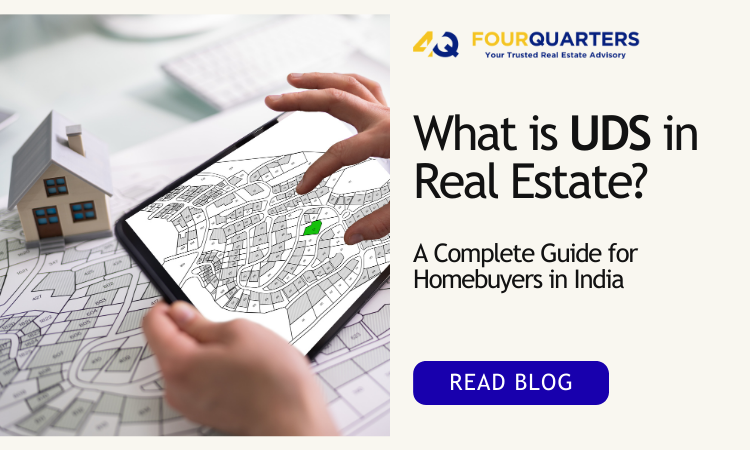
UDS (Undivided Share of Land) refers to the portion of land legally owned by an individual apartment owner in a residential project. Since multiple apartments are built on a single land parcel, the land cannot be physically divided. Instead, each buyer gets a proportionate share of the total land, which is called the undivided share.
For example, if an apartment project is built on 10,000 sq. ft of land with 10 equal-sized flats, each owner typically holds a 1,000 sq. ft UDS—regardless of the floor they live on.
Why is UDS Important in Real Estate?
UDS is not just a technical term—it directly affects the value, legality, and future potential of your property.
1. True Ownership Lies in the Land
Buildings depreciate over time, but land appreciates. Your real asset is not the flat structure—it’s your share of the land beneath it. Higher UDS generally means stronger long-term value.
2. Redevelopment & Reconstruction Rights
If a building becomes old or is approved for redevelopment, owners with higher UDS receive better compensation or larger rebuilt homes. Low UDS can reduce your bargaining power.
3. Legal Security
UDS is mentioned in the sale deed. Clear UDS allocation ensures proper legal ownership and reduces disputes among owners or with developers.
4. Better Resale Value
Apartments with higher UDS tend to attract more informed buyers and command better resale prices, especially in prime city locations.
How is UDS Calculated?
UDS is calculated using the following formula:
UDS = (Your apartment’s super built-up area ÷ Total super built-up area of all flats) × Total land area
Example:
- Total land area: 20,000 sq. ft.
- Total super built-up area of project: 40,000 sq. ft.
- Your flat’s super built-up area: 2,000 sq. ft.
Your UDS = (2,000 ÷ 40,000) × 20,000 = 1,000 sq. ft.
This calculation shows why super built-up area matters, not just carpet area.

What is a good UDS?
There’s no universal “perfect” UDS, but here are general indicators:
- Low-rise apartments → Higher UDS per flat
- High-rise towers → Lower UDS due to more units
- Luxury or premium projects → Usually higher UDS
- Overcrowded developments → Lower UDS (red flag)
As a buyer, always compare UDS per square foot of carpet area, not just the total UDS number.
Common Myths About UDS
Myth 1: Higher floor = higher UDS
❌ False. UDS is independent of floor level.
Myth 2: Amenities increase UDS
❌ Amenities don’t change your land share.
Myth 3: UDS doesn’t matter for end-users
❌ Even end-users benefit during resale or redevelopment.
What Should Buyers Check Before Purchasing?
Before finalizing a property, ensure:
- UDS is clearly mentioned in the sale deed
- Land title is clear and approved
- Total land area matches sanctioned plans
- The builder is not inflating super built-up area unfairly
This is where expert guidance becomes critical.
Understanding UDS is essential for making an informed property decision, as it reflects the buyer’s actual ownership of land and directly influences long-term value. A well-defined and proportionate UDS ensures legal clarity, safeguards ownership rights, and plays a crucial role during redevelopment or reconstruction in the future. Properties with balanced UDS allocation tend to offer better appreciation potential and stronger resale demand, while low or unclear UDS can increase risk despite attractive pricing or amenities. Evaluating UDS alongside carpet area, location, and pricing helps buyers assess the true investment quality of a residential property rather than relying only on built-up space.
Final Thoughts
UDS in real estate is one of the most underrated yet powerful factors in property ownership. While it may seem technical, understanding it can protect your investment, enhance resale value, and secure your rights in the long run.
Before you buy your next home, don’t just ask about price and amenities—ask about UDS.
And if you need trusted guidance, FourQuarters is here to help you every step of the way.