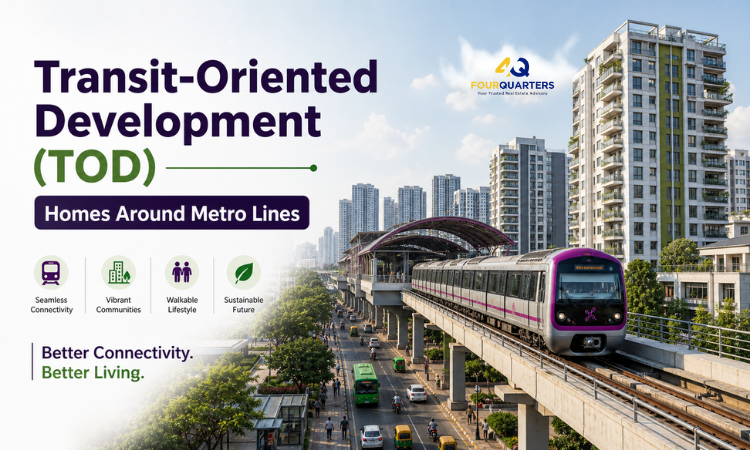

What is Transit-Oriented Development (TOD)?
Transit-Oriented Development (TOD) is a forward-thinking urban planning approach where residential, commercial, and lifestyle developments are strategically located within walking distance (typically 500m to 1km) of major public transport hubs such as metro stations.
The concept is centered around creating well-connected, self-sustained communities that reduce dependence on private vehicles while enhancing accessibility and convenience. In a rapidly growing city like Bangalore, TOD is playing a crucial role in shaping modern real estate development and urban living patterns.
With metro connectivity becoming the backbone of the city’s infrastructure, TOD is not just a planning concept—it is a lifestyle transformation.
Why TOD is Important in Bangalore Real Estate
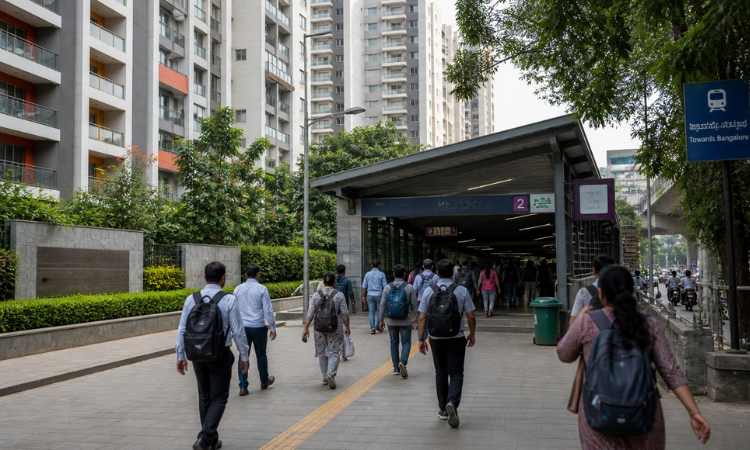
Bangalore has long been known for its thriving IT ecosystem, vibrant lifestyle, and expanding urban footprint. However, with this growth comes increasing demand for efficient mobility and better connectivity. This is where TOD becomes highly relevant.
The expansion of metro corridors across key zones has redefined how people evaluate property locations. Today, properties near metro stations in Bangalore are among the most sought-after due to the direct impact on daily commutes and overall convenience.
TOD contributes to the city’s growth by:
- Enabling seamless connectivity across major business districts
- Supporting planned and structured urban expansion
- Encouraging sustainable and eco-friendly living
- Reducing travel time and improving productivity
In essence, TOD aligns perfectly with the needs of a modern urban population that values time, accessibility, and quality of life.
How TOD Impacts Properties Near Metro Lines
1. Strong and Consistent Property Appreciation
One of the most significant advantages of TOD is its influence on property appreciation in Bangalore. As metro connectivity improves, surrounding areas experience increased demand, leading to steady and long-term value growth.
Infrastructure development acts as a catalyst, attracting residential and commercial investments. Over time, this creates a ripple effect where real estate near metro stations becomes more valuable and desirable.
2. High Rental Demand and Better Returns
Metro-connected locations are highly preferred by working professionals, especially in a city driven by IT and corporate sectors. This results in strong rental demand in Bangalore for homes near metro lines.
Properties in such locations tend to offer:
- Consistent tenant demand
- Better rental yields
- Lower vacancy rates
For investors, this makes flats near metro stations in Bangalore a reliable and income-generating asset.
3. Enhanced Lifestyle and Everyday Convenience
Living close to a metro station brings unmatched convenience. Residents benefit from quick and easy access to workplaces, educational institutions, healthcare facilities, and entertainment hubs.
This significantly reduces commute stress and allows more time for personal and family life. As a result, apartments near metro connectivity in Bangalore are increasingly preferred by homebuyers seeking a balanced lifestyle.
4. Premium Location Advantage
Connectivity is one of the strongest drivers of real estate value, and metro access enhances a location’s overall appeal. Homes near metro corridors are often perceived as prime properties in Bangalore, attracting both end-users and investors.
This premium positioning not only boosts demand but also strengthens the long-term potential of the property.
5. Rise of Modern and Integrated Developments
TOD encourages the development of high-rise residential projects, integrated townships, and mixed-use communities. These developments are designed to offer a complete living experience, combining homes, retail spaces, and offices within close proximity.
Such projects elevate the overall standard of living by providing:
- Better infrastructure
- Modern amenities
- Well-planned layouts and open spaces
This makes new projects near metro stations in Bangalore highly attractive in today’s market.
6. Future-Ready and Sustainable Living
TOD promotes a lifestyle that is aligned with sustainable urban development. By reducing reliance on private vehicles, it contributes to:
- Lower traffic congestion
- Reduced carbon footprint
- Improved urban efficiency
For homebuyers, this means investing in a future-ready property that aligns with evolving city dynamics and environmental considerations.
Also Read: Floor Space Index (FSI) in India: Definition, Formula & City-Wise Comparison
Bangalore Real Estate Perspective
The impact of metro connectivity is already visible across several high-growth corridors in Bangalore. Areas such as Whitefield, East Bangalore, Outer Ring Road (ORR), and North Bangalore are witnessing increased demand due to expanding metro networks.
These locations are evolving into key real estate hotspots, driven by infrastructure, employment hubs, and improved accessibility. As metro expansion continues, the demand for apartments near metro stations in Bangalore is expected to grow even further.
For both homebuyers and investors, this presents an opportunity to be part of well-connected, high-potential neighborhoods.
Conclusion
Transit-Oriented Development is redefining the landscape of Bangalore real estate by placing connectivity at the core of urban living. With advantages such as strong property appreciation, high rental demand, enhanced lifestyle convenience, and premium location value, homes around metro lines offer a compelling proposition.
As the city continues to expand and infrastructure strengthens, metro-connected developments stand out as future-ready investments that combine both lifestyle and long-term value.
FourQuarters believes that aligning property choices with key growth drivers like metro connectivity enables homebuyers and investors to make well-informed and rewarding real estate decisions in Bangalore.