When it comes to real estate, whether you’re an investor, homebuyer, or developer, one term that often comes up but remains misunderstood is Floor Space Index (FSI), also known as Floor Area Ratio (FAR). This simple number plays a huge role in determining how much construction can happen on a given plot of land, which in turn affects property prices, design, and even the way cities grow. At FourQuarters, we believe that making informed decisions in real estate starts with understanding these fundamentals.
What is Floor Space Index (FSI)?
In simple words, FSI is the ratio between the total built-up area of a building and the total area of the plot on which it stands. It defines how much floor area you can construct relative to the land size.
For example:
- If you own a 1,000 sq. ft. plot and the permissible FSI is 1.5, you can build up to 1,500 sq. ft. of floor space (spread across one or more floors).
This calculation makes FSI a vital parameter for architects, builders, and buyers to plan how tall or spacious a building can be.
How is FSI Calculated?
The formula for FSI is straightforward:
FSI = Total Built-up Area / Plot Area
Let’s break it down with an example:
- Plot Area: 2,000 sq. ft.
- Permissible FSI: 2.0
- Total Built-up Area Allowed: 2,000 × 2.0 = 4,000 sq. ft.
This 4,000 sq. ft. can be divided across multiple floors depending on the local building rules. A builder might choose to make four floors of 1,000 sq. ft. each or two floors of 2,000 sq. ft.
Factors That Influence FSI
FSI is not the same everywhere. It depends on:
- City Development Rules – Metro cities usually allow higher FSI to support vertical growth, while smaller towns maintain lower FSI to control density.
- Location & Road Width – Properties on wider roads or in premium zones often have higher permissible FSI.
- Type of Property – Residential, commercial, and industrial plots all have different FSI rules.
- Government Policies – Special relaxations or premium FSI can be purchased in certain zones to allow more construction.
Why is FSI Important?
1. Guides Urban Development
FSI directly impacts city planning. A higher FSI means taller buildings, which maximize land use in crowded cities. A lower FSI preserves open spaces and avoids congestion.
2. Impacts Property Value
The permissible FSI affects the resale value of land. For example, a plot with a higher FSI allows more construction, which often makes it more valuable to developers.
3. Influences Home Design
For buyers, FSI determines the number of floors, apartments, or amenities in a project. This affects the density of residents, open space availability, and quality of living.
4. Ensures Legal Compliance
Buildings constructed beyond permissible FSI are considered illegal and may face demolition or penalties. Understanding FSI helps buyers ensure they are investing in a legally compliant property.
5. Affects Infrastructure Load
FSI regulations help balance the load on city infrastructure—roads, water supply, drainage, and electricity—by controlling how many people can live or work in a given area.
FSI in the Indian Real Estate Context
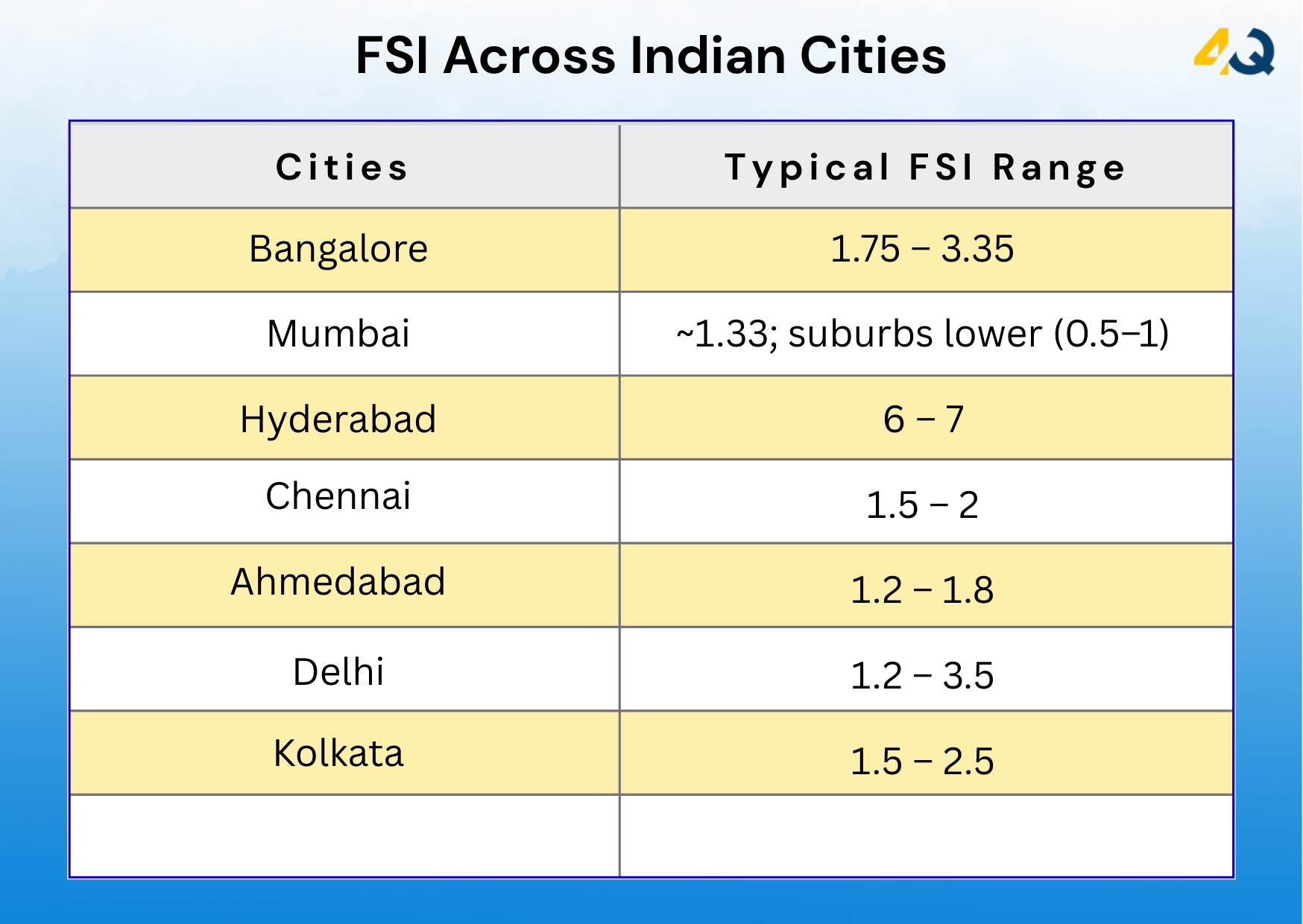
In India, FSI varies widely:
- Mumbai allows higher FSI (sometimes up to 5 in redevelopment projects) due to limited land availability.
- Bangalore has FSI ranging between 1.5 and 3 depending on location and road width.
- Delhi also sets FSI differently across residential colonies, commercial areas, and industrial zones.
Government initiatives like Transit-Oriented Development (TOD) also influence FSI, encouraging higher density near metro corridors and public transport routes.
Common Misconceptions About FSI
- “Higher FSI always means better living.” Not always. While higher FSI allows more units, it may reduce open space, increase congestion, and put pressure on amenities.
- “FSI is the only factor to consider.” Other regulations like Floor Area Coverage (FAR), setbacks, and building height restrictions also matter.
- “All projects use maximum FSI.” Developers sometimes use lower FSI to maintain exclusivity, luxury, or open green space in premium projects.
Also Read – Understanding the Roles of BBMP, BMRDA, BDA, and DTCP in Land Approval
Why Should Homebuyers Care About FSI?
If you’re buying a home or investing in land, knowing the FSI can:
- Protect you from buying into illegal constructions.
- Help you estimate the project’s density (more units vs. fewer units).
- Give insights into long-term value appreciation of your property.
For investors, understanding FSI allows smarter choices about where land and property value may rise due to potential redevelopment.
FourQuarters Perspective
At FourQuarters, we believe real estate decisions should never be made in the dark. By simplifying complex concepts like FSI, we empower buyers and investors to make choices that align with their goals. Whether you’re looking for a spacious villa, a luxury apartment, or a smart investment in upcoming developments, knowing how FSI works ensures transparency and smarter planning.
Conclusion
Floor Space Index is more than just a number—it’s a framework that shapes how our cities look, how our homes are designed, and how property values grow. For homebuyers and investors, understanding FSI ensures legal compliance, smarter investments, and a better quality of life.
At FourQuarters, we guide you through not just properties but the knowledge that makes real estate decisions more confident and future-ready. Because the right information is the foundation of every successful investment.